|
A e-mail I just recived...very insiteful
Are drag kings going to perform at the Michigan Women's Music Festival
STAGE STATEMENT
http://www.chicagofreepress.com/vanasco/index.html
Two years ago a small group of Chicago lesbians were thinking up ways
to get local women "up off their...couches," as they say now. They
came up with an idea cribbed from other cities: start a drag king
troupe.
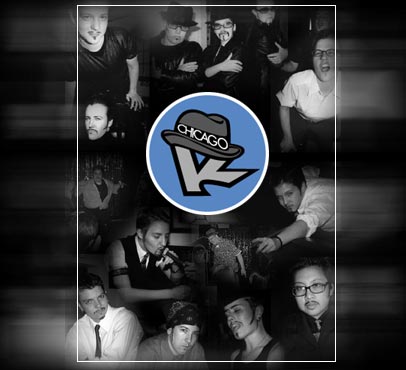
More than 70 performances later the Chicago Kings are one of the top
troupes in the country. They're rock stars within the community-women
scream when they appear, slip dollar bills into their pants and flirt
outrageously.
The Kings are entertainers and so they talk about what they do in
personal terms-how liberating it is for them to perform like this,
what a high they feel. For most of them it is nothing more than pure
fun.
But a recent talk by Columbia College Chicago professor Amy Hawkins
made me wonder if the Kings aren't much more than that. Perhaps
they're not just women dressing up in male clothes, pasting on facial
hair and lip-syncing to groovy music. Perhaps they're the lynchpin
for a new cultural movement-and in the process are helping redefine
what it means to be a lesbian.
Defining lesbians, of course, has never been easy. The best
definition seems to be something along the lines of "a woman-
affiliated-woman who has sex with other women" but that's pretty
vague. Lesbians have been defined as angry and man-hating or as women
who wear comfortable shoes.
But for a long time the philosophical center of the lesbian community
was based in the idea of understanding, appreciating and listening to
other women and in the rejection of masculine structures and ways of
acting. Thanks to 1970s feminism much of the lesbian community
focused on the collective process: women would adjust their desires
based on what the group decided was good for the community.
Now the philosophical center seems to have shifted. And drag king
troupes are helping promote (if not lead) that change, however
inadvertently. This is not good or bad, necessarily. It just is.
In the world of the Kings what is central is one's sexual desires. In
their performances and their personas, the Kings encourage sexual and
gender play. Hawkins links them with women's sex shops and the rise
of women-oriented burlesque.
"This is a lesbian culture different from the lesbian feminist
culture of the 1970s," Hawkins said. "Lesbian feminists don't talk
about desire-they talk about collective rights. I think the
difference is that the Kings say that desire is my right. My right is
to desire anything I want, and if that is a girl dressed up as a boy,
that's my right. The idea that you should be just a woman-centered-
woman, period, is just really, really limited. Why would you want to
limit your understanding of culture, of desire? That's like saying
there's only one kind of real lesbian, one kind of authentic lesbian."
In other words, this brave new world of women in their 20s and 30s
isn't organized around political action and equal treatment. It's
organized around sexuality, which is why the drag kings appeal to so
many people, no matter what their gender or sexual orientation. This
is a cultural moment that says we should all be free to explore the
many facets of our sexuality and gender, no matter where it might
lead us. No lesbian-bed-death myth for these girls.
This is interesting to me, because it has traditionally been the gay
male community that has been organized around sex. Women have prided
themselves on not being lookist or ageist-part of me worries that
with this new emphasis on sexuality instead of activism, that will
change (or, perhaps, it has changed already).
Also, I'm fascinated-and a little concerned-that so much of this new
emphasis on sexuality is centered around the idea of men or the male
gaze. In burlesque shows women perform for other women-but they
perform in a way that men have typically considered sexy. There's a
lot of bump and grind, tits and ass.
Drag kings are parodies, of course, but they're also sexual objects
for the lesbian community in a way that drag queens are not for gay
men. This gives lesbians the power to both express their own
masculinity and express their attraction to masculinity in others.
But instead of asking professor Judith Halberstam's question of "what
is female masculinity?" drag kings seem merely to ape the masculine
qualities of the worst types of men. Part of this seems to be
treating women who play more traditional types of women with less
respect-though I understand that the Chicago Kings are working hard
to battle that within their troupe.
On the other hand, sex is good and I'm glad lesbians are having more
of the guilt-free variety. In our conservative country it is
refreshing to see the rich diversity of human sexuality publicly
celebrated instead of condemned. I find the Chicago Kings and
especially the burlesque revival to be fun, silly, sexy
entertainment. It's the larger message that concerns me in any case,
not the individual performances.
Hawkins says I shouldn't worry. Kings are playfully reclaiming the
butch and femme dyad for the better, she says; burlesque is
reclaiming the idea that if women want to be obviously sexual, that
should be OK. Both types of performances, she says, are ways of
increasing female power.
"This is about what you like and what you do," Hawkins says. "I don't
think drag kings change the culture-I think that people are
responding to what they like. Kinging is both smart and fun. It's not
that we just sit around and drink together-we're going to have fun
and be thinking, too."
A lot to think about, indeed.
Email Jennifer Vanasco at vanasco@chicagofreepress.com.
|
|